Interesting Ideas

Book Review: Shaved Ice and Wild Buses: Street Art in Suriname

Posted in Art, Book Review, Outsider Art, Roadside Art, Vernacular Art on May 16th, 2012

Schaafijs en wilde bussen: Straatkunst in Suriname, by Chandra van Binnendijk , Paul Faber and Tammo Schuringa, KIT Publishers, 160 pages, 2010. ISBN 978-9-4602-2054-8. Dutch, soft cover, 19.50 euros

Shaved Ice and Wild Buses: Street Art in Suriname

Kit Pubishers, the same Dutch company behind African Signs, also crossed the ocean to document the decorated buses and snow cone stands of Surname, a former Dutch colony next to Guyana in South America.

Shaved Ice and Wild Buses: Street Art in Suriname, published in conjunction with exhibits in that country and the Netherlands, is an ideal coffee table book if you don’t happen to speak Dutch – you can just look at the photos without guilt.

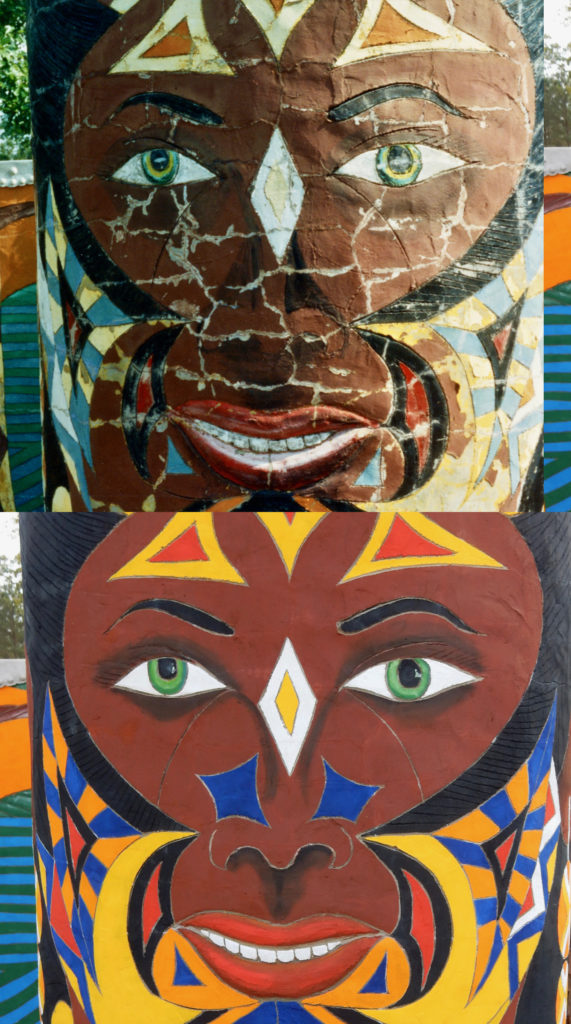
The book documents a tradition of decorating small urban buses said to go back to the 1970s. Many of these images are more polished than the African signs in the previous books, and their scale is often small –medallions painted above the license plates that look to be just a foot or two square.

The shaved ice carts are much smaller than the buses yet seem more monumentally decorated, perhaps because the paintings tend to cover the entire carts. The style on the carts also seems more varied, in some cases similar to the bus images but in others more personal, with some being outright pornographic.

The explicit scenes aside, most of the paintings on both buses and carts show celebrities ranging from Bob Marley to Jessica Simpson, Britney Spears and a bevy of movie stars, both Hollywood and Bollywood varieties. Political figures also turn up, including Saddam Hussein, Osama bin Laden, Nelson Mandela and Mohandas Gandi. A particularly nice image shows George W. Bush, labeled the Boss, gesturing between two seated, almost angel-like, babes.

For good measure the book supplements the buses and carts with a number of wall paintings and concludes with biographies and photos of a number of artists, again unfortunately all in Dutch.

Click here to view a video of this material and artists producing it.

Review: Touchless Automatic Wonder: Found Text Photographs from the Real World

Posted in Art on May 13th, 2012

Touchless Automatic Wonder: Found Text Photographs from the Real World
Touchless Automatic Wonder: Found Text Photographs from the Real World by Lewis Koch
My rating: 5 of 5 stars

Wisconsin photographer Lewis Koch provides very powerful settings for found text.

View all my reviews

Book Review: South African Township Barbershops and Salons

Posted in Art, Book Review, Outsider Art, Roadside Art, Vernacular Art on April 5th, 2012

South African Township Barbershops and Salons, Simon Weller, Mark Batty Publisher, 128 pages, 2011. ISBN 978-1-935613-04-6. Hard cover $27.95

If African Signs, with its minimal text but rich collection of photographs, provides a window to African vernacular culture, South African Township Barbershops & Salons passes through that window to provide something of an inside tour. Simon Weller, a professional photographer, not only document numerous advertising signs but also spent time with the hair cutters and their customers as well as several sign painters. He aims not just to show the art but also the culture in which the art is embedded. That took him across much of South Africa, both cities and countryside, and into place that few whites, let alone tourists, every visit. In one rural district he asked whether anyone had ever photographed the shops and founds only one case, and that was a government official documenting a structure for possible demolition.

Seeing inside the ramshackle structures, many of them converted steel shipping containers, gives a richer sense of the businesses the signs advertise, including details like their reliance on car batteries for their source of electricity. Weller also sketches the history of strife and the current poverty that are as part of the vernacular as any of the painted images. He observed that the poorer the community, the more the barber shops and salons serve as centers for community interaction.

The artists Weller interviews demonstrate as much variance in their stories as in the styles on view in their work. An artist known as Smoky, active in Soweto, told Weller he had wanted to be an artist since he was five and studied art in college. He paints what he considers fine art but also does commercial signs for income. He works fast, taking from 45 minutes to 2 hours to complete a commercial work.

Chris Masekela, from a rural area outside Pretoria, is self-taught and reports being “inspired by an art gallery that I used to see when I came to town and became interested in white man’s art.”

“I like black man’s art but I like white artists because they show real life and draw towns and people, for instance showing guys playing dice. Black art only shows traditional things like a black woman carrying a calabash on her heard, going to fetch water from the river.”

Masekela’s portraits have a definite edge to them and for whatever reason seem to show less of the American influence (often hiphop in nature) that characterizes much of this work and is widely acknowledged by the artists and their customers.

Weller found another artist who produces versions of his shop signs for sale. Durban painter Espoir Kennedy – actually a refugee from Burundi — said he sells hair signs in a gallery for $95 while charging $40 for actual shop banners.

Click here to see a selection of photos from the book.

This review originally appeared in The Outsider, magazine of Intuit: The Center for Intuitive and Outsider Art.

Review: The Calumet Region: An American Place

Posted in Art on March 30th, 2012

The Calumet Region: An American Place
The Calumet Region: An American Place by Gregg Hertzlieb
My rating: 5 of 5 stars

A wonderful book, with photos of places I’ve been wanting to photograph for years.

View all my reviews

Review: The Iliad

Posted in Art on March 13th, 2012

The Iliad
The Iliad by Homer
My rating: 5 of 5 stars

An eminently readable translation brings the appalling gore, risible gods, tragic heroes and wondrous poetry to life. A great way to reacquaint, or acquaint, yourself with one of the world’s great works of literature. My reading partners via readingodyssey.org help a lot too.

View all my reviews

Review: Ancient Greece: A Very Short Introduction

Posted in Art on March 13th, 2012

Ancient Greece: A Very Short Introduction
Ancient Greece: A Very Short Introduction by Paul Cartledge
My rating: 4 of 5 stars

Cartledge makes an admirable run at covering a thousand years of history in just a few pages. His focus on key themes and representative cities results in a nicely coherent introduction.

View all my reviews

The Beauty of Silence

Posted in Art on February 12th, 2012

Just saw The Artist. It reminds me of what was lost when sound came into the movies. Filmmakers achieved an amazing level of visual sophistication and power before sound, and it took years — some would say decades — to regain the artistic momentum stopped dead by sounds’ enormous technical overhead. Indeed, there is an argument that the artistic requirements of building movies around dialogue are inherently at odds with realizing their full visual potential. That’s a bit overstated, but there’s a point to it. If The Artist, produced when filmmakers are basically amateurs in the art of silent movies, could be so moving and popular, think of what silent film professionals could accomplish. But sound not only makes that commercially moot, it inherently takes emphasis away from the pure abstract impact that visuals and music can achieve when alone together.

Book Review: African Signs

Posted in Art, Book Review, Outsider Art, Roadside Art, Vernacular Art on February 11th, 2012

African Signs, by Rob Floor, Gert van Zanten andPaul Faber, KIT Publishers, 208 pages, 2010. ISBN 978-9-4602-2080-7. Soft cover $45

African Signs

Every once in a while those of us who don’t often make it to Africa have an opportunity to glimpse the continent’s extraordinary commercial visual culture. As recently as this summer vibrant examples of hand-painted movie posters from the 1980s and ‘90s were on view at the Chicago Cultural Center, which also mounted a show in 1996 of elaborate decorated coffins from Ghana. Both genres have books devoted to the,

African hair salon and barber shop signs, meanwhile, were featured in an Intuit show in 1994 and have become what might be the most widely collected hand-made trade signs since those of 18th and 19th Century American came into vogue. These signs are popular enough that many of the examples that end up for sale abroad are apparently made specifically for export.

African Signs is a broad survey of Africa’s commercially inflected vernacular art. It collects hand-painted signs, mostly photographed in situ, across a number of categories, including food, clothing, health, electronics and the ubiquitous hair. Among other things, the book shows off a scale of work that can’t be grasped from the individual signs collected in the U.S. That scale includes many mural-size images, but also remarkable photo that shows more than a dozen individual signs displayed outside a pharmacy in Togo. And these being health signs, the explicit representation of ailments – some obvious and some obscure but many just gross — is easily as disturbing as the kitschy violence seen in the low-budget movie posters featured in the Extreme Canvas book and the Chicago Cultural Center show.

There is certainly a kitsch element contributing to the appeal of some of these signs, but only some. The degree of talent evident in them also varies, reflecting apparently low barriers to entry for the signs’ producers. As the introduction notes, the continent is generally too poor to produce the art school graduates who might otherwise populate a commercial art industry. But the need for commercial art in the continent’s thriving local markets has produced a demand for creativity that is ripe to be filled in interesting and creative ways.

Paul Faber, the museum curator who wrote the book’s introduction, tracked down one of these artists, who goes by the interesting name of “Middle Art.” Faber notes that Middle Art is one “of the hundreds of professional painters in Africa who don’t see themselves as ‘artists’ in the romantic sense … but as craftsman who make a living with paint and brushes. This modesty can also be found in the name ‘Middle Art.’ … He doesn’t consider himself very bad but also not very good, just Middle Art.”

However accurate Middle Art’s judgment of his own ability may, the talent displayed in this book is impressive if unpredictable. Some artists can’t manage much more than caricature, other produce nuanced portraits. Some show flights of imagination, others lavish loving attention on the most mundane (or sometimes bizarre) subjects.

This review originally appeared in The Outsider, magazine of Intuit: The Center for Intuitive and Outsider Art.

Review: Brooklyn Storefronts

Posted in Art on February 1st, 2012

Brooklyn Storefronts
Brooklyn Storefronts by Paul Lacy
My rating: 5 of 5 stars

A lovely collection of artistic shop signs, tastefully photographed and displayed.

View all my reviews

Review: The Flirt

Posted in Art on January 31st, 2012

The Flirt
The Flirt by Booth Tarkington
My rating: 4 of 5 stars

The Flirt, like so many Tarkington stories, is first of all an exercise in gentleness. Tarkington loved his characters to a fault. To his heroes and heroines he showed gentle affection, to his comic relief gentle condescension, and to his villains gentle contempt. All that gentleness throws up a fog of good feeling, but behind the fog there are crags and cliffs of unhappiness, struggle and decay. In the fog is nostalgic escapism to what seems like a “simpler” time and place. But life turns out to be the same depressing, uphill scramble it always is, especially amid the dislocations of the early 20th Century – Tarkington’s most persistent and greatest theme.

View all my reviews


Copyright 2009 William Swislow