
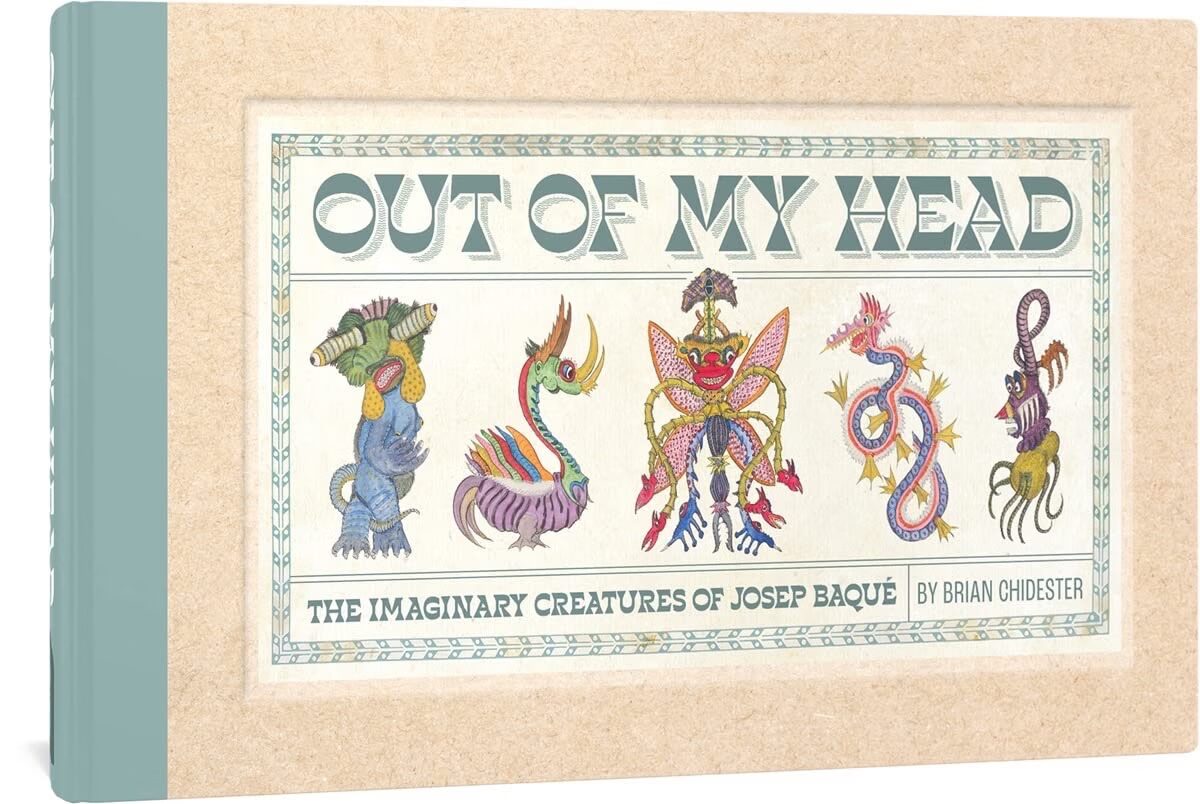
Out of My Head: The Imaginary Creatures of Josep Baqué,
by Brian Chidester and Josep Baqué, Fantagraphics Books, 538 pages, color illustrations, 2023. ISBN 978-1683966814. Hardcover, $49.99.
If you grew up watching Japanese superhero shows like Ultraman or the Power Rangers, you might have been amazed at the far-fetched creatures they invented week after week for the heroes to fight. Many of these monsters made Godzilla look unimaginative. How could they not eventually run out of ideas?
Josep Baqué, a Barcelona policeman, left 1,500 drawings of equally fantastical creatures, each one more bizarre than the last.
His reasons for creating this menagerie remain obscure. He neither sold nor published his work, which was spread over 454 notebook pages. This new 6×11-inch volume is close to an actual-size facsimile.
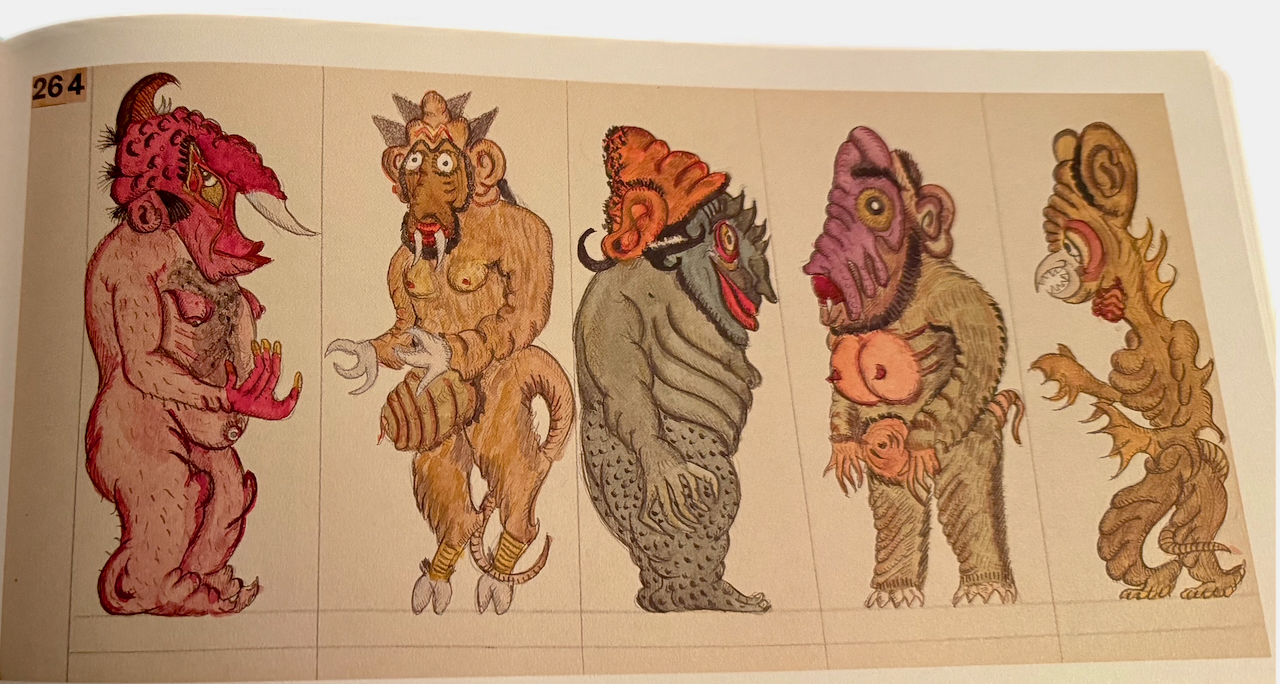
What it contains is an endless combination of the fantastic and the zoological. The creatures Baqué depicts are reminiscent of the Blengin dragons created by his near-contemporary, Henry Darger (and at times also somewhat Seussian). But Baque’s creatures are generally more grounded, if no less bizarre than Darger’s, and he stretched his imagination to create far more examples than populated Darger’s world.
He rendered most of them with wonderful patterns and coloring, and they are all dripping with personality, not to mention occasional gender ambiguity (another commonality between Baqué and Darger). Breasts and various genitalia abound in strange combinations.
You could spend hours getting to know just a few pages worth of these wholly bizarre but vivid creatures. Some were clearly intended to be funny, some scary. Many were just pointless flights of fancy.
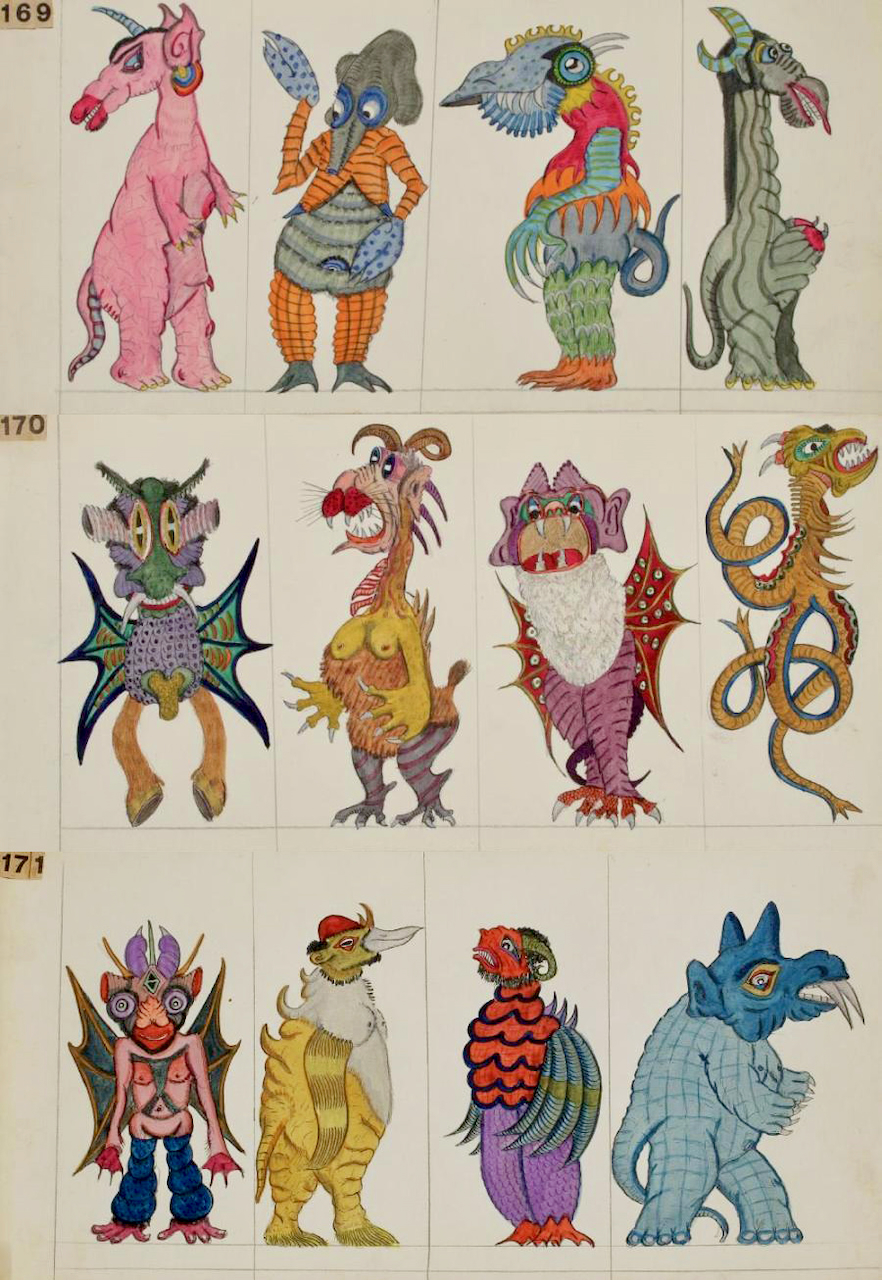
Many of them also face forward, making direct eye contact with the reader, which helps explain why they are so engaging. And even the side-facing ones still seem to be looking at someone, perhaps each other, perhaps their creator. All are expressive — happy, sad, weary, quizzical, amused, confused, bored, upset, angry, occasionally horrifying.
Perhaps most remarkable is the way these exotic fantasies hold together, their absurdity made visually credible by the force of Baqué’s vision. Every one of them seems to have a story, so powerfully is his imagination embedded in the drawings.
He clearly never grew tired of the exercise, with the creatures coming later in the book as fanciful and elaborate as the early ones.
Baqué was born in Barcelona in 1895 and spent time in France, Germany and Belgium. He ultimately returned to Barcelona, where he became a police officer in 1928, a position he held until his death in 1967. He was a devout Catholic, and earlier in his life worked as an engraver of headstones.
He is believed to have started the drawing project in 1932, but almost nothing Is known about his artistic practice or why he created this body of work. He appeared to be decidedly solitary, though it also appears he lived for years with a woman who, it seems, only really became known to the family after his death. A relative kept the bestiary in a cupboard for decades afterward.
It wound up in the possession of Amsterdam collector Lucas Reitalov. In 2014 the Collection de l’Art Brut in Lausanne exhibited some of the drawings, and now the entire body of work has been published by Fantagraphics Books, best known as a publisher of comics and cartoon art. Art historian Brian Chidester supplies commentary.
What little is known about the artist comes from the account of a nephew, but Chidester tries hard to unpack meaning, especially political meaning, despite the absence of knowable background. And rightly, after a lot of raising and dismissing possibilities that are speculative at best, he throws up his hands.
“Of course, it could also be that the work, like so much which emanates from the realm of creativity, is beyond verbal/rational interpretation; that the bestiary essentially becomes its own explanation; and that whatever feeling the images evoke in the viewer is their meaning,” Chidester writes.
Baque’s own explanation is of limited use in this exercise. He wrote at the front of his book: “Interior of some marvelous large islands at 2 million meters above sea level, unexplored, uninhabitable by civilized beings, a country of warm snow, discovered by the brush of Josep Baqué.”
That’s about it for context. Baque’s intentions, like his beliefs, remain stubbornly obscure. We are left to enjoy these creatures for what we can see they are, and nothing more. But that’s plenty.