
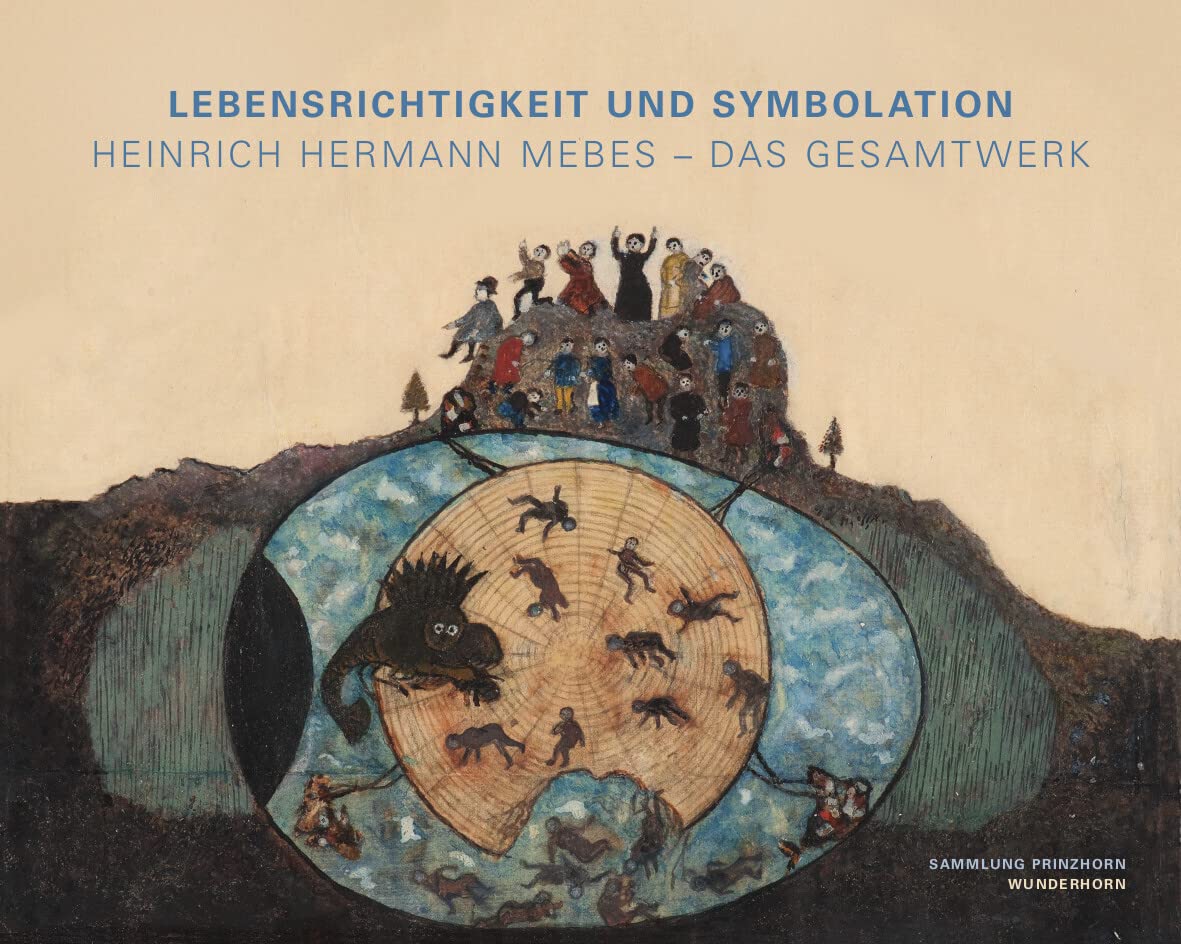
Symbolization and the correctness of life, by Heinrich Herrmann Mebes – The Complete Works, by Thomas Röske, The Prinzhorn Collection/Wunderhorn, 548 pages, many illustrations, 2023. ISBN 978-3884236802. Hardcover, 70 Euros
When German psychiatrist Hans Prinzhorn published his pioneering study Artistry of the Mentally Ill in 1922, he gave reduced attention to two artists, thinking that each deserved an individual publication. Those projects never materialized, but Prinzhorn’s namesake collection in Heidelberg published an Else Blankenhorn book in 2022 and now has come out with a hefty volume collecting the work of Heinrich Mebes.
Mebes, by profession a watchmaker, was married, had four children and seemed to live a conventional life through the late 1880s. But after a brief asylum stay in 1878 he ultimately entered the Eberswalde asylum in Germany 10 years later, where he remained until he died at 76 in 1918.
He left behind five books packed with writing and illustrations that were sent to Prinzhorn. Though the pages of these wildly imaginative books were occasionally exhibited over the years, it took more than a century for them to be published in full.
The book is in German, with no English translations, though translation software can provide at least a sense of the texts. It’s impossible, though, for a non-German speaker to tell when the strangeness of those texts is a function of computer translation or of Mebes’ eccentricity.
And even if you can read German, the writing is eccentrically written and cryptic, according to Thomas Röske, director of the Prinzhorn collection and editor of this volume.

“The texts are difficult to understand, especially because the sentences rarely follow common grammatical constructions and often remain incomplete,” Röske says, while Prinzhorn himself described a “highly mannered, oracularly dark language.”
One brief example, supplied by Google Translate: “Dying for the security of life takes on the grace of life. In being tormented: faithfully loves the existing love of immutability.”
There might be some virtue, though, in not being able to read Mebes’ writing, which fills many pages of these books completely as well as providing captions to most of the pictures.
“I will soon write in peace — if I do not lose myself too deeply in gnostic and mystical-pietistic problems, which I have tackled for a few days for the ‘watchman’ and will continue over Christmas,” Prinzhorn wrote in a letter about the Mebes books.
The drawings themselves, ranging from folky angels to pure abstraction, also threaten to suck the viewer into something mysterious even without the benefit of written explanations. While they do not quite reach the brilliance of, say, Hilma af Klint’s otherworldly abstractions, Mebes’ images are equally concerned with spiritual matters, and often more disturbing. Even the superficially prosaic images of everyday occurrences seem charged with a pointed spiritual undercurrent.
They are also quite good and beautifully detailed, whether depicting arcane symbols, delicate flowers, the fate of sinners or just geometric forms.
Röske bravely tries to interpret the esoteric scenes and symbols in Mebes’ images but can only take it so far.
About a lightning-and-fire-filled illustration of the Cain and Abel murder, Röske asks, “How can further details be interpreted? Why does the murderer hold a small saucepan in the fire with his outstretched left hand…? Why is he carrying an open large pair of scissors in the other hand?” As Röske goes on to describe, “The fire is lit in an unusual frame for a glassy vessel with a round end and a high pointed tower on it. In the vessel, an owl squats on round stones, an inverted cross under it, which is stuck between two small circle faces with empty-staring eyes and line mouths. Some moths swirl around the structure.”
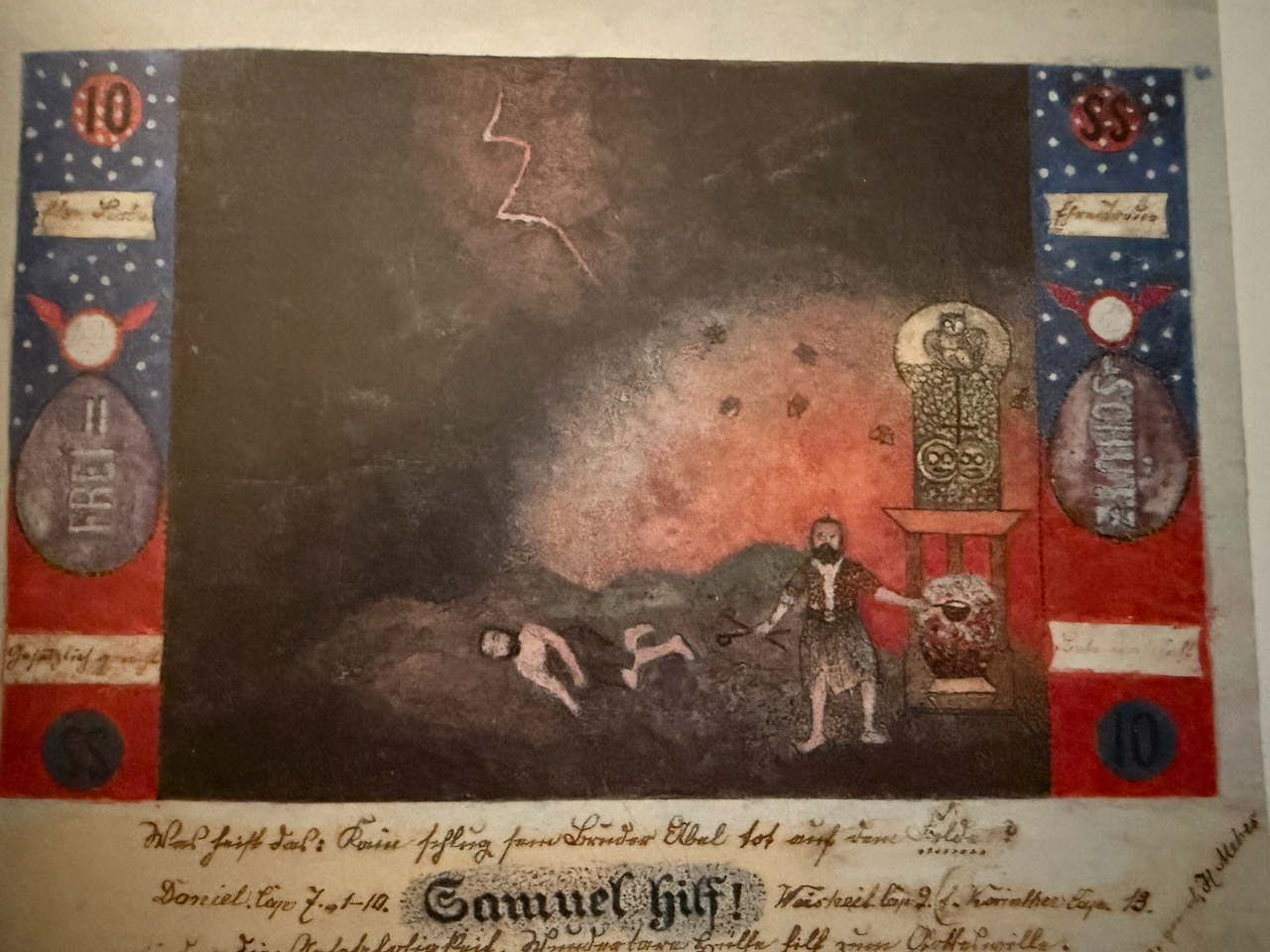
As he inevitably concludes: “The picture signs, and certainly their combination, cannot be decoded throughout.”
Whatever the challenges of interpreting the writing or the images, two themes come do across.
While Mebes seems to have been obsessed with traditional notions of sin and redemption, Röske writes that his concept of sin could be idiosyncratic. “He criticized one particular wrongdoing more often than any other: the ‘useless” birth.’ Mebes saw the world as suffering from overpopulation, the result of people following ‘desire,’ the lust of the flesh, instead of divine love.”
But oddly, it was birthing more than the sex act, that seemed to draw his ire.
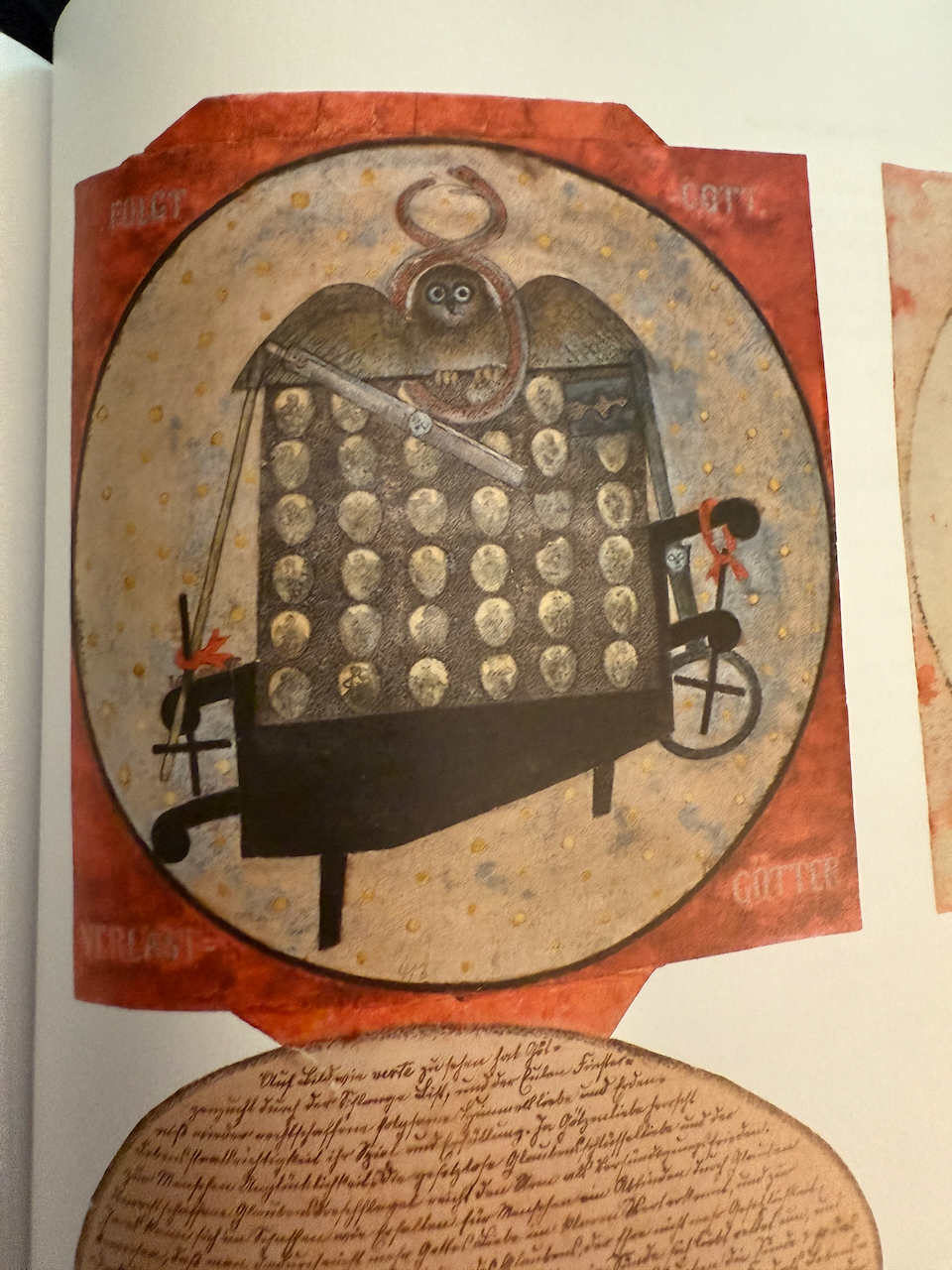
The other theme: “Instead of showing insight into the disease, he repeatedly vehemently protested against his ‘lawless imprisonment,’ which was for him a screaming expression of a malicious misunderstanding of his life,” Röske says.
“What do I have to do in the madhouse?” Mebes repeatedly asked.
It is believed that Mebes began to draw in 1899. None of these early works survived. Most likely they were routinely destroyed by caretakers. In 1912 he started on the five books and other drawings that were preserved, probably because of the growing interest of psychiatrists like Prinzhorn.
This facsimile includes a detailed account of the books and their painstaking reassembly.
“Pictures are irregularly scattered in the books he himself tied with threads, sometimes fill whole, sometimes half pages, protrude in the text or form vignettes, are partly framed by character frames and executed as single-colored pen drawings or detailed multicolored gouaches.”
It’s clear that some pages had been removed, including by Prinzhorn himself, but the team for this project did a great job putting things back together and showing the work in its many facets.
Be warned that the images are tiny, reflecting, perhaps, a watchmaker’s comfort with small detail. The original books themselves are all apparently less than a foot tall. The small magnifying lens thoughtfully provided with this volume helps a bit, but more helpful are the few images shown enlarged on some pages. It would be fabulous if at some point a companion volume of expanded images could be made available or perhaps published as an online archive. And, of course, an English edition as well.