Interesting Ideas

Archive for the 'Book Review' Category

Book Review: African Signs

Posted in Art, Book Review, Outsider Art, Roadside Art, Vernacular Art on February 11th, 2012

African Signs, by Rob Floor, Gert van Zanten andPaul Faber, KIT Publishers, 208 pages, 2010. ISBN 978-9-4602-2080-7. Soft cover $45

African Signs

Every once in a while those of us who don’t often make it to Africa have an opportunity to glimpse the continent’s extraordinary commercial visual culture. As recently as this summer vibrant examples of hand-painted movie posters from the 1980s and ‘90s were on view at the Chicago Cultural Center, which also mounted a show in 1996 of elaborate decorated coffins from Ghana. Both genres have books devoted to the,

African hair salon and barber shop signs, meanwhile, were featured in an Intuit show in 1994 and have become what might be the most widely collected hand-made trade signs since those of 18th and 19th Century American came into vogue. These signs are popular enough that many of the examples that end up for sale abroad are apparently made specifically for export.

African Signs is a broad survey of Africa’s commercially inflected vernacular art. It collects hand-painted signs, mostly photographed in situ, across a number of categories, including food, clothing, health, electronics and the ubiquitous hair. Among other things, the book shows off a scale of work that can’t be grasped from the individual signs collected in the U.S. That scale includes many mural-size images, but also remarkable photo that shows more than a dozen individual signs displayed outside a pharmacy in Togo. And these being health signs, the explicit representation of ailments – some obvious and some obscure but many just gross — is easily as disturbing as the kitschy violence seen in the low-budget movie posters featured in the Extreme Canvas book and the Chicago Cultural Center show.

There is certainly a kitsch element contributing to the appeal of some of these signs, but only some. The degree of talent evident in them also varies, reflecting apparently low barriers to entry for the signs’ producers. As the introduction notes, the continent is generally too poor to produce the art school graduates who might otherwise populate a commercial art industry. But the need for commercial art in the continent’s thriving local markets has produced a demand for creativity that is ripe to be filled in interesting and creative ways.

Paul Faber, the museum curator who wrote the book’s introduction, tracked down one of these artists, who goes by the interesting name of “Middle Art.” Faber notes that Middle Art is one “of the hundreds of professional painters in Africa who don’t see themselves as ‘artists’ in the romantic sense … but as craftsman who make a living with paint and brushes. This modesty can also be found in the name ‘Middle Art.’ … He doesn’t consider himself very bad but also not very good, just Middle Art.”

However accurate Middle Art’s judgment of his own ability may, the talent displayed in this book is impressive if unpredictable. Some artists can’t manage much more than caricature, other produce nuanced portraits. Some show flights of imagination, others lavish loving attention on the most mundane (or sometimes bizarre) subjects.

This review originally appeared in The Outsider, magazine of Intuit: The Center for Intuitive and Outsider Art.

Book Review: Friedrich Schröder-Sonnenstern

Posted in Art, Book Review, Outsider Art on January 28th, 2012

Friedrich Schröder-Sonnenstern, essay by Pamela Kort. Michael Werner Gallery, 2011. ISBN: 978-1-8850-1381-1. Paperback $55

Friedrich Schroder-Sonnenstern book reviewFriedrich Schroder-Sonnenstern images of unexcelled symbolic intensity marked him as one of the most creative German artists of the mid-20th Century, but also an artist whose weirdly eroticized work was unlikely to be found on gallery walls in his own time. He was also hugely eccentric, putting in time as both a charlatan occultist and a mental patient, according to Pamela Kort’s essay in the recently published catalog for the exhibit From Barefoot Prophet to Avant-Garde Artist at Michael Werner Gallery in New York.

His serious production of art began with no training and minimal preparation, resulting in an effusion of highly idiosyncratic pictures. Combined with his mental health history it could sound like a typical art brut biography, but the story does not necessarily conform to the usual script. Kort argues that his time in mental institutions should not be taken at face value. He was troubled, certainly, and eccentric, but not necessarily insane.

Indeed, Schroder-Sonnenstern was hardly an isolate who labored in obscurity. Early in his artistic career he participated in a local art discussion group. More importantly, his work was recognized and promoted by such luminaries such as Marcel Duchamp, Andre Breton and Hans Bellmer and exhibited in surrealistic shows. But Schroder-Sonnenstern’s art did not fit into the aesthetic conversation that dominated the post-war German art world, and he remained virtually unknown in his own country, according to Kort.

Kort devotes much attention to the artist’s medical history, but mostly to make thae case (a bit ironically) that his mental health should not be over-emphasized. Her view is that a focus on his purported schizophrenia only serves to marginalize his work, in his own time and ours, and that in any case may have reflected the man’s disrepute more than a real diagnosis.

If she spends a bit too much time assessing his mental state, in the process she provides plenty of interesting biographical details about a man whose life was in fact very interesting, art aside. In the years after World War I he was active as a mystic, clairvoyant and quack healer, although Kort does not think he had much belief in those callings. But this is a case where even the most fascinating biography pales in the context of the art itself.

His typically pulchritudinous figures appear in a variety more or less threatening scenes, with violence suggested or explicit but almost always understated. The titles are as cryptic as the symbols in the work – “The Moralistic Moon Dualism,” “Zynus Theory – whether Demon of Desiccation and Withering” and “The People’s Joyful Miraculous Shirt, or the Moralistic Scarecrow.”

Kort takes her best shot at interpreting the mind-bending symbolism, but it’s not easy. The complexity of her explanations, however admirable the effort, simply can’t keep pace with the art she is attempting to interpret.

The one thing that can be said clearly about this enigmatic artist is that his status as a true outsider is unshakable. Not because of anything about this personality or work but for the simple reason that he was twice refused membership in the Bildender Künstler Berlin, the Berlin Association of Visual Artists.

This review originally appeared in The Outsider, magazine of Intuit: The Center for Intuitive and Outsider Art.

Book Review: John Margolies, Roadside America

Posted in Art, Book Review, Roadside Art, Vernacular Art on October 25th, 2010

John Margolies, Roadside America, edited by Jim Heimann, with contributions by Phil Patton, C. Ford Peatross and photos by John Margolies. Taschen, 288 pages, about 400 color photos, 2010. ISBN: 978-3-8365-1173-5. Hard cover $39.99.
John Margolies, Roadside America
The enthusiasm for vernacular expression that began flowering in the United States in the 1970s never quite gelled into a unified movement. Yet a new generation did learn to value the work of self-taught artists and a sizable coterie of writers, photographers, architects and others discovered an exterior landscape whose aesthetic dimension was almost entirely accidental, but all the more striking for it.
Read the rest of this entry »

Book Review: Mary Nohl Inside and Outside

Posted in Art, Book Review, Outsider Art on April 18th, 2010

Mary Nohl Inside & Outside: Biography of the Artist, by Barbara Manger and Janine Smith. University of Wisconsin Press, 134 pages, 165 color images, 145 b/w or sepia images, 2009. ISBN 978-0-6152-5118-9. Soft Cover $29.95.

See my Mary Nohl photos, circa 1990
NohlCover1

The first time I saw Mary Nohl’s masterpiece of a home and yard I only knew I was being taken to “The Witch’s House.”

That was its name for a generation of neighborhood kids, including the two who were showing me the one big curiosity in Fox Point, Wisconsin.

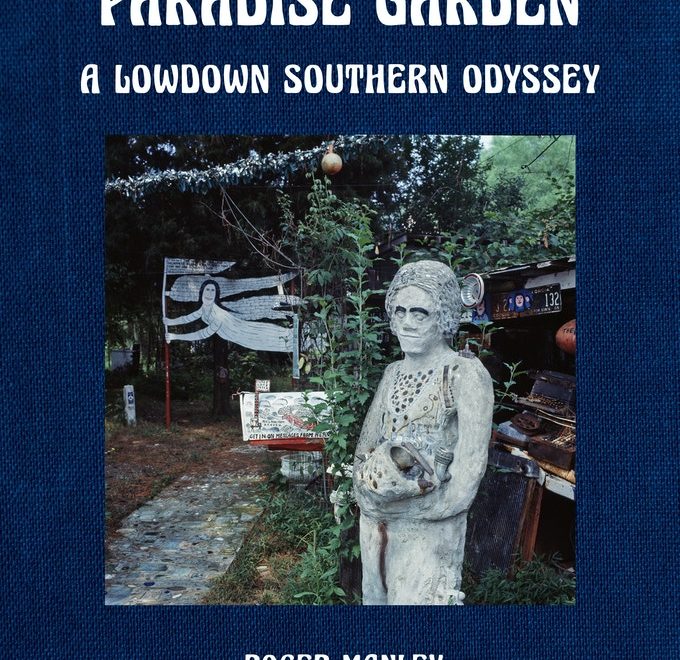
The reason for the visit was Nohl’s eccentricity, which made her yard a target for vandals as well as a local landmark. But it didn’t take long to see that the art was far more important than the oddity. I had visited a couple of art environments at that time, including Howard Finster’s Paradise Garden near Summerville, Georgia, and Nohl’s place was clearly one of those. It may have seemed more domestic than heroic, tucked away next to Lake Michigan in its comfortable corner of suburban Milwaukee, but it constituted a clear statement of her personal vision.
Read the rest of this entry »

Book Review: Martin Ramirez: The Last Works

Posted in Art, Book Review, Culture, Outsider Art on March 31st, 2009

Martin Ramirez: The Last Works, by Brooke Davis Anderson, Richard Rodriguez and Wayne Thiebaud. Pomegranate, 160 pages, 136 illustrations, 2008. ISBN 978-0-7649-4695-0
Martin Ramirez: The Last Works
The ratio of text to photos in this second major volume dedicated to Martin Ramirez is low, and that comes as a relief to someone who feels compelled to read books front to back, even when not reviewing them.

The catalog published last year in conjunction with Ramirez’s epochal one-man at the American Folk Art Museum had many virtues. Contributions by Anderson and by Victor and Kristin Espinosa supplied essential (and in the Espinosas’ case ground-breaking) background and perspective. But several of the more than half-dozen essays felt like heft more than light.

Read the rest of this entry »

Book Review: Painting a Hidden Life: The Art of Bill Traylor

Posted in Art, Book Review, Culture, Outsider Art on March 31st, 2009

Painting a Hidden Life: The Art of Bill Traylor, by Mechal Sobel. LSU Press, 256 pages, 46 illustrations, 2009. ISBN 978-0-8071-3401-6
Painting A Hidden Life: The Art of Bill Traylor

Pity the poor dead outsider artist. Odds are good you’ve been reduced to a collection of anecdotes gathered by an early collector or dealer then recycled, with declining fidelity, through biographical capsules, reviews and newspaper articles. Your life is a series of clichés attached to a stunning body of work.

If you’re exceptionally lucky, like Martin Ramirez, you may eventually pique the interest of serious scholars and become the subject of actual biography. But when your life story is a matter of luck, it can go either way. Witness Bill Traylor, an artist on par with Ramirez in importance and depth, but a test case for a different treatment, a genre that might be labeled “speculative biography.”

Read the rest of this entry »

Book Review: Follies of Europe – Architectural Extravaganzas

Posted in Art, Book Review, Outsider Art, Roadside Art, Vernacular Art on September 21st, 2008

Follies of Europe: Architectural Extravaganzas, by Nic Barlow, Caroline Holmes and Tim Knox. Garden Art Press, 256 pages, 286 color illustrations, 2008. ISBN 1-87067-356-5

Book Review: Follies of EuropeIn the United States, writing on the environments of self-taught artists tends to place them within the outsider art context or, sometimes, within a specifically American tradition of individual expression.

Follies of Europe demonstrates a very different way of looking at these sites. Not only is their individualistic exuberance not distinctly American, but they belong to a tradition of highly personal outdoor extravaganzas going back at least to the 17th Century. Indeed, the book opens with reference to Roman gardens decorated with miniature temples and palaces, which are folly structures par excellence.
Read the rest of this entry »

Book Review: Collecting Madness – Outsider Art from the Dammann Collection

Posted in Art, Book Review, Outsider Art on September 21st, 2008

Collecting Madness: Outsider Art from the Dammann Collection, by Thomas Röske, Bettina Brand-Claussen, Gerhard Dammann and others. Catalog by the Prinzhorn Collection, 224 pages, 101 illustrations, 2006. ISBN: 3-88423-265-7

Book Review: Collecting MadnessIt may seem like a cheap shot to call this volume schizophrenic, but between its own punning title and its divided sense of purpose, the description is irresistible.

“Collecting Madness” refers both to the mania of acquisition and to a particular exhibit of a German collection focused on work by artists with histories of mental problems and confinement in asylums. The catalog itself is divided by an abrupt transition halfway through, switching from fascinating explorations of art collecting to a series of rather conventional considerations of specific art works and artists.
Read the rest of this entry »

Book Review: The Air Loom and Other Dangerous Influencing Machines

Posted in Art, Book Review, Culture, Outsider Art on September 21st, 2008

Book Review: The Air Loom and Other Dangerous Influencing Machines, by Thomas Röske, Bettina Brand-Claussen and others. Catalog by the Prinzhorn Collection, 256 pages, 92 illustrations, 2006. ISBN: 3-88423-237-1.

Book Review: The Air LoomThis book, also a catalog for an exhibit at the Prinzhorn Collection, is even more focused on psychiatric issues than the Collecting Madness volume.

In an earlier time that could have been problematic, but the success of Dubuffet and his followers in liberating the art from its psychiatric context actually makes it easier to appreciate the insights. Although there is still plenty to debate relating to terminology and the significance of biography, the specifically medical terrain no longer feels like an impediment to aesthetic value.
Read the rest of this entry »

Book Review: Sublime Spaces And Visionary Worlds

Posted in Art, Book Review, Outsider Art, Vernacular Art on May 10th, 2008

Sublime Spaces And Visionary Worlds: Built Environments Of Vernacular Artists, By Leslie Umberger, Erika Doss, Lisa Stone, Jane Bianco and Ruth Kohler. Princeton Architectural Press, 424 pages, 650 color plates and 100 black and white illustrations, 2007. ISBN 1-56898-728-5

This is a blockbuster catalog for a blockbuster show, and perhaps the best book yet published on the subject of art environments.

The structure is conventional—a handful of essays bookend a set of illustrated biographical vignettes (22 in this case, with exceptionally rich photo reproduction). But intelligence and serious intent distinguish this effort from the usual run of coffee table books. The straightforward biography focuses on understanding how the environments and their artists developed, which is especially relevant in a context where the work’s physical evolution illuminates both its meaning and its current state of being. This is a non-incidental consideration for nearly every one of these sites, given their exposure to the elements and to a sometimes-hostile populace. Read the rest of this entry »


Copyright 2009 William Swislow