
This strategy is by no means exclusive to smalltime capitalists. Even if it's not the kind of excellence typically touted in business books, institutionalized incompetence drives impressive results.
For real-world leadership, look to the health insurance industry. The case study should be familiar to anyone who has been assailed with the mysterious EOB, the incoherent billing or the impenetrable customer service, and just given up. The natural tendency when faced with these stonewalls is to attribute them to organizational flaws -- a lame employee or overactive attorney here, a dysfunctional software application there. But is it plausible that insurance companies don't know exactly how many people give up on claims, what those claims are worth, and what incremental investment income they stand to realize every day that claim fulfillment is delayed, if not prevented altogether? These are companies whose actuaries, after all, calculate risk and value to the penny for virtually every earthly activity.
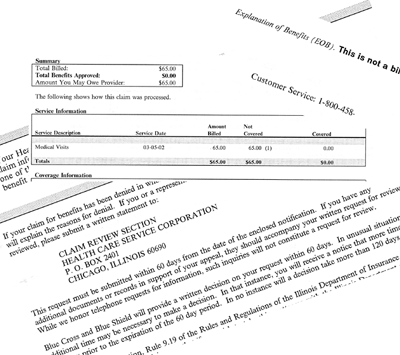
The economics amount to a calculation of what unresolved "mistakes" are worth vs. the cost of the additional CSR minutes devoted to not addressing them. It's not rocket science to put those economics into effect. Anyone familiar with enterprise software knows how easy it is to allow a broken billing system to just churn away. On the customer-service side, consciously managing an otherwise capable work force into poor performance is one way to deliver laggard service. But low pay, stressful working environments and employee churn must be far more efficient. They can guarantee hours of call-center frustration while never straying from acceptable business practices. Plus, they mask the real goal from those tasked with delivering it.
Put another way, even if lousy customer service were not the plan, insurers have no compelling reason to fix a profitable problem. Tolerating systems that make life miserable for the bill-paying public lets them prosper. The incentive is structural.
There is a price for the ill will this creates, but it's not immediately economic, so why should the big insurers care? Between their power, the medical establishment's and the entrenched ideological resistance to national health, they haven't had to worry much about the political frustrations of the sick. The health-care choice that matters to insurers - picking a carrier - is made by employers, not patients. Not many companies can afford to let efficiency in handling claims drive that choice. As large institutions like the Detroit automakers wake up to the burden of this remarkably unproductive system, things might change. But there are plenty of profits to be squeezed in the meantime.
Corporate FUD
Health insurance might be the most economically significant instance of industrial-strength incompetence, but it is by no means unique. Consider a large corporation that is strategically dependent on partnerships but is as feared as it is admired. Its management is known for such brilliance that everything it does is thought to play into an ulterior strategy of total domination.
Faced with this perception, the company has some creative options for ordinary business negotiations. How about accidentally leaving internal comments in a proposed contract draft? Systematically overwriting attachments with outdated versions? Fielding uncertainty and confusion on every negotiating call? Wasting breath addressing issues that no one with any sense - certainly no one with any brilliance -- would be concerned with? It's just these missteps that can constitute the company's brilliance.
Confronted with an overwhelming succession of careless errors and unable to get even a basic channel of communication established, the potential partner is likely to be as amazed by its apparent superiority as it is confused about what is really at stake. Even if the parent is bent on hegemony, the particular corner you're dealing with looks to be muddling through as best it can, so cut it some slack.
Incompetence is the ultimate excuse for not articulating actual goals. Someone incapable of explaining plans probably didn't formulate many in the first place. In this fog of misdirection, the partner is liable to back off its own requirements, give up on points that are hopelessly misunderstood and just plain miss the strategic issues that really matter.
Spiritual dimensions
The intentional application of incompetence is not restricted to commercial transactions. Did not the Fall of man require God to affect a degree of inattentiveness not plausible for an omniscient being? As atheists have pointed out through the ages, it's hard to explain the whole existence-of-evil thing without wondering whether God is all there. In fact, many Christians embrace the point. Calvinists would say that an omnipotent God must intend evil to exist. The epochal error in the Garden is how God establishes the faithfulness of his creations. Or, in the anti-Calvinist interpretation, God's apparent slip forms the basis of free will. In either case, the devil's existence reflects the conscious, strategic application of incompetence.
The devil himself makes much of the incompetence principle in Peter Cook's fabulous comedy, Bedazzled, a movie with tremendous lessons for business life. No matter how carefully Dudley Moore's mopey Stanley specifies requirements for his soul-selling wishes, they all misfire due to Satan's putative misunderstandings.
Anyone who has ever delivered specifications for a technology project can relate to Stanley's plight. It is the self-evident points requiring no comment that get ignored or misconstrued to undermine the whole effort. And every effort to nail down the last detail just turns up a more obscure one to take the project off track. Satan's mix-ups are more malicious than typical technology best practices, but the effect is the same.
Republican advantage
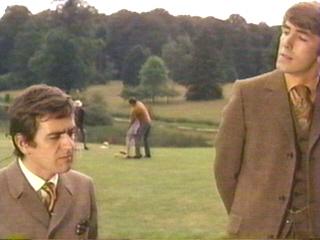
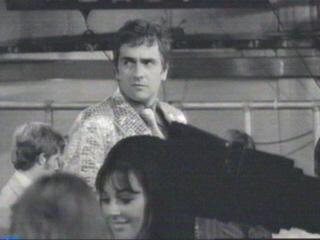


Peter Cook's Satan keeps sabotaging the innocent wishes of Dudley Moore's Stanley. Stanley's final wish: I'm with the girl I love for the rest of our lives, we are good, moral people who love each other very much, are kind, content and love no one else. Satan makes them nuns together. Coincidence or hoax?
Richard Nixon demonstrated the downside of a smart presidency when no one could reasonably doubt that he knew exactly what was going on with Watergate. The Republicans learned their lesson, however. Gerald Ford was the first step in a flight from intelligence that only appeared to reach its climax with Ronald Reagan. Reagan's deniability was entirely plausible when he said he had no idea that Oliver North & Co. had deliberately flouted the Constitution.
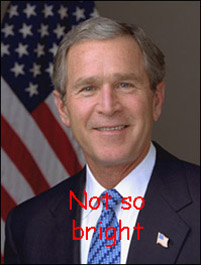
But no one could have known then that someone would soon top the Great Communicator in the high-level ignorance department. It is George W. Bush's great achievement that he is credibly aggrieved when blamed for the weapons-of-mass-destruction ruse -- or blamed for anything. No acting is necessarily. That old royal governing trick just comes naturally to our current president: Where unavoidable, blame much more believably attaches to the scheming or overenthusiastic or misguided or just plain capable underlings who went too far.
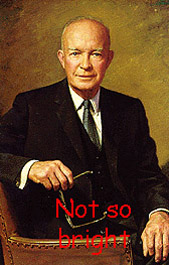
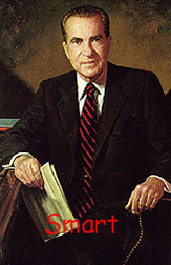
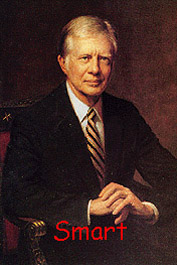
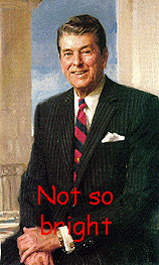
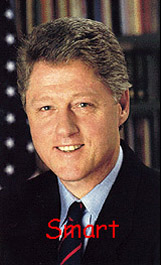
| The risks of presidential intelligence are quite apparent, and not only in Richard Nixon's case. It's the apparently smart presidents that have been the most vilified in the post-war years, while the perceived dimwits get a pass. Note that this is about perceptions, not actual intelligence. Ford and Eisenhower were certainly far smarter than their images would suggest, but in this context it is image that matters. So this is just an observation, not scientific, but consider: | ||
| ||
|
|
|
|
Presidents perceived as smart were widely loathed, in their time and after, with the contempt in most cases spreading far beyond the usual opposition. Carter, perhaps the smartest of the bunch, has suffered the longest-lasting political disgrace. Even most Democrats can't stand the idea of his presidency, whatever they think of his post-office activities. Had he not been martyred, it seems likely that Kennedy would have run into the same hostility as other brainy presidents. As for the elder Bush, it's taken for granted that he has more on the ball than the son. But not enough to get into the ranks of the truly despised. Although the younger Bush, like Reagan, arguably is as widely hated by the left as Clinton was by the right, it has barely affected his administration. Unlike Reagan and Bush, the apparently dimmest presidents in generations, Clinton was politically crippled by a hostility that poisoned perceptions of his administration across the political spectrum. He was too knowledgeable not to know the depths of his own sleaziness. Most Americans just don't trust smart leaders. As for the rest, apathy and defeatism are the certainly not coincidental consequences of presidential idiocy. | ||
|
The Latest Stuff | Roadside art | Outsider pages | The idea barn | About | Home
Copyright Interesting Ideas 2005 |